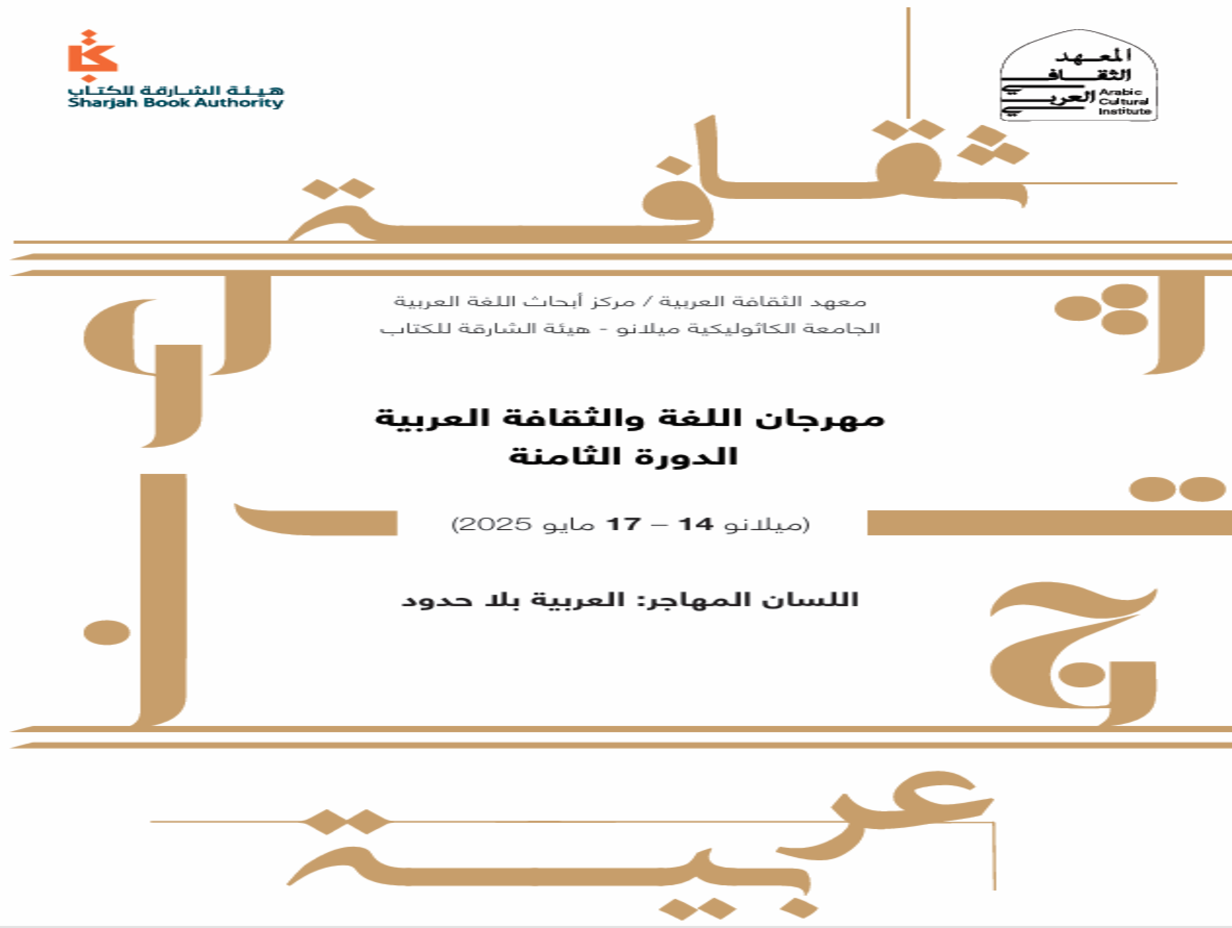
The migrating language: Arabic without borders
Festival at a glance
From 14 to 17 May 2025, Università Cattolica del Sacro Cuore in Milan hosted the eighth edition of the International Festival of Arabic Language and Culture, organised by the Arabic Cultural Institute (ACI) in collaboration with the Sharjah Book Authority, which has been a partner of the initiative since 2019.
Since its creation in 2014, the Festival has maintained its distinctive twofold structure: an academic and scientific dimension, represented by a conference bringing together more than thirty leading academics, intellectuals, writers, and artists from eighteen countries across the Arab world and the West; and a socio-cultural and public engagement dimension, featuring cultural and artistic events that offer students, Arabic language learners, academics, and the wider public an opportunity to experience the richness of Arabic language, culture, and artistic expression.
The Festival also provides a valuable opportunity for members of local Arab communities to reconnect with, explore, and deepen their cultural heritage.
The theme of the 2025 edition, “The Migrating Language: Arabic Without Borders,” developed around two complementary perspectives: “Speaking the Language of the Other,” which focused on the teaching and learning of Arabic in non-Arabic-speaking contexts, and “Living in the Language of the Other,” which explored Arabic literature of the diaspora and writing in exile.
During the opening session, Wael Farouq, Professor of Arabic Language and Culture at Università Cattolica, Director of the ACI, and founder of the Festival, explained the significance of this theme:
"The presence of the Other has always been a driving force behind the development of the Arabic language, from the foundation of Arabic linguistic sciences — shaped also by scholars of Persian, Byzantine, and Berber origins — to modern Orientalism, which, despite its limitations and biases, represented a new phase in the study of Arabic language sciences through modern scientific approaches."
He further emphasised that Arabic has played a fundamental role in preserving and transmitting the intellectual heritage of civilisations from East to West, contributing to a historical process that later influenced the European Renaissance.
According to Farouq, contemporary Arab migration to Western countries represents a new turning point in relations between cultures, with Arabic language and literature playing a central role:
"Beyond millions of bilingual migrants, a significant number of Arab writers who have moved to Western countries now write directly in European languages, creating a new literary landscape worthy of attention and study. At the same time, the teaching of contemporary Arabic has expanded significantly in Western universities. We are witnessing a new ‘departure’ of Arabic beyond its geographical and cultural boundaries, a phenomenon that deserves to be explored and understood."
International festival of Arabic language and culture